Tuesday, March 3, 2009

Red Fort Agra - Agra, India

About 2 km from the Taj, on the banks of the river Yamuna, stands the imposing Agra Fort. It was during the reign of Emperor Akbar that the city of Agra reached its pinnacle of glory. During his reign, the main part of the Agra fort was built. The fort, which was first constructed in AD1156 and was finished by Akbar in the year 1605. Most of the buildings inside the fortress were erected by Shahjahan. While most parts of the fort was used as a military bastion, a portion of it was used as a court as by Shahjahan.

Structure of the Fort:
The fort stretches almost 2.5 km alongside the Yamuna river. It is enclosed by a wall built in red sandstone and has several buildings inside. Though the fort has two gates- the Delhi Gate and the Amar Singh Gate- access can be gained only via the Amar Singh Gate. The entire fort is not opened to tourists, for part of it is nowadays used by the Indian Army. But still it has enough to give an insight into the 16th century Mughal lifestyle. It was the very place where Emperor Shahjahan was confined till death by his son Aurangzeb. Shahjahan is said to have died in the Musamman Burj, a tower with a beautiful marble balcony, which provides the most captivating views of the Taj.
Inside the fort there is the Great Courtyard, towards the right of which lies the multi- pillared Diwan-i-Am (Hall of Public Audience), built by Shahjahan in 1628. Next, there are the Royal Pavilions. The fort houses two beautiful mosques- Nagina Masjid & Mina Masjid. There are the splendid palaces- Macchi Bhavan, Khas Mahal, Shish Mahal and Shah Jahani Mahal. Besides, there is also the Zenana Mina Bazaar. Many of the buildings are made of pure marble and embellished exquisite carvings. An interesting feature of the rooms in the marble pavilions is that the walls were hollow and filled with running water to provide a cooling effect. The balconies in the pavilions provide some eyeful views of the Yamuna and the Taj.

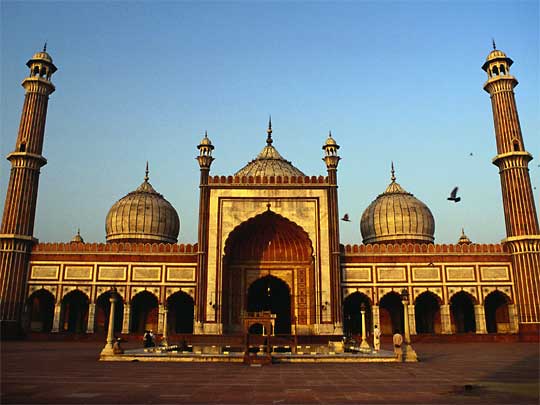
Jaama Masjid - Delhi, India

The Jama Masjid has the distinction of being the largest Mosque in the country. It lies opposite the Red Fort and is flanked by a plethora of shops dealing in a variety of goods. This great mosque is the final gift of Shahjahan to the architectural heritage of India. Planned and designed by the great sculptor, Ostaad Khalil, the Masjid is said to be the replica of Moti Masjid in Agra. It is called Masjid-e-Jahanuma. About 5000 artisans were employed to accomplish the task of constructing this Rs. 10 crore architectural marvel.
Structure of the Mosque
The mosque is constructed in a style of alternating vertical stripes of red sandstone and white marble, and measuring 65m by 35m. Of the three imposing gateways- the main eastern entrance, which remains closed on most days of the week, was perhaps used by the Emperors. The north and the south gates, accessed by broad flights of steps, were meant for the common people. The structure was placed on a high platform so that its magnificent facade would be visible from all around. The pulpit, shaped out of a single block of marble, is one of the hallmarks of the mosque. The mosque is also adorned by four towers and two minarets.
Precious Possessions of the Mosque
A cupboard near the North Gate of the Jama Masjid contains some priceless relics of Prophet Mohammed. These include a chapter of his original Koran written on deerskin, a red beard-hair of the prophet, his sandals and his footprint, embedded on a marble slab.

Fatehpur Sikri - Agra, India

About 37 km west of Agra, this royal city was founded as his dream capital by the Mughal Emperor Akbar. There is a legend behind the construction of this splendid city. Akbar was without an heir for a long time. Therefore, he made a pilgrimage to the renowned Sufi saint Sheik Salim Chisti and sought his blessings for a successor. Finally, a son was born to him, who later came to be known as Jehangir. As a mark of his gratitude, Akbar named him after the saint and built the new capital to mark his birth. Work on the extensive project- featuring grand palaces, formal courtyards, pools, harems, tombs and a great mosque- began in 1571. A large number of skilled masons and craftsmen worked to their bones on an area that was over two miles long and a mile wide. The main material used for construction was red sandstone, which is available locally.
But destiny has its own way- just after fifteen years of the completion of work, the fabulous city had to be abandoned due to acute shortage of water.

Fatehpur Sikri: The Cynosure of all Eyes
This magnificent city, today, is recognized as a World Heritage site. Inside the complex there are number of mesmerizing sites. The Panch Mahal, or Palace of Five Storeys, and the Buland Darwaza, a massive gate which provides entrance to the complex, are adored for their unrivaled elegance. The massive chess board signifies the cultural politics inherent in the Mughal era. On this board, as it is believed, human figures were used as chess pieces and moved at the will of the emperor. The Jama Masjid (Imperial Mosque), Salim Chisti tomb, Diwani-Aam, and Jodh Bai's Palace feature among the most impressive structures of the city. The city is notable for its intricate blend of Muslim and Hindu motifs.