Tuesday, March 3, 2009

Taj Mahal - Agra, India


India's $42 billion travel and tourism industry today has secured itself the fifth rank amongst the 134 most preferred tourist destinations in the world. With over 3 million tourists visiting the the Seventh Wonder of the World - the Taj Mahal - alone every year, the floodlights were focused at Agra, until globetrotters began to look around. They found India studded with delights more than many and gradually the attractions were unraveled, one after the other.
The architectural archipelago that India is, owes its genesis to the various dynasties that ruled different parts of India at different periods. The most significant embossing on the Indian landscape was that of the Mughals and the erstwhile British masters. The Mughals believed in luxuriant living and their palaces were a rich blend of Indo-Islamic and Persian architecture. Their fascination for gardens got a whole legion of them laid at different parts of their territory. The British brought in their Victorian and Gothic elements and built monuments of use (railway stations, educational institutions, museums et al), while the Rajput and the Gupta rulers, keeping in with their jealous territorial stronghold, got some of the most splendid Palaces and Forts built. South India, of the Chandelas and the Pallavas, boasts of some of the most magnificent temples. India's coastline, hill-stations, adventure trails and so on, are recent boosts of the tourism industry and needless to say, they have surpassed the oldies.
We have randomly handpicked the most popular tourist attractions in India so that you know what not-to-miss.

Tokyo T.V Tower - Tokyo Japan

Tokyo Tower is a communications and observation tower located in Shiba Paark, Minato, Tokyo, Japan. At 333 meters (1,091 ft), it is the tallest self-supporting steel structure in the world and the tallest artificial structure in Japan. The structure is an Eiffel Tower-inspired Lattice Tower that is painted white and international orange to comply with air safety regulations.
Built in 1958, the tower's main sources of revenue are tourism and antenna leasing. Over 150 million people have visited the tower since its opening. FootTown, a 4-story building located directly under the tower, houses museums, restaurants and shops. Departing from here, guests can visit two observation decks. The 2-story Main Observatory is located at 150 meters (492 ft), while the smaller Special Observatory reaches a height of 250 meters (820 ft).
The tower acts as a support structure for an antenna. Originally intended for television broadcasting, radio antennas were installed in 1961 and the tower is now used to broadcast both signals for Japanese media outlets such as NHK, TBS and Fuji TV. Japan's planned switch from analog to digital for all television broadcasting by July 2011 is problematic, however. Tokyo Tower's current height is not high enough to adequately support complete terrestrial digital broadcasting to the area. A taller digital broadcasting tower known as Tokyo Sky Tree is currently planned to open in 2011.

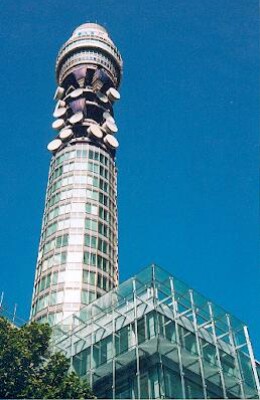
B.T. (Post Office)- London, UK

The B.T. (Post Office) Tower was officially opened by Prime Minister Harold Wilson on 8 October 1965. Its purpose was to act as the hub of a nationwide network of microwave relay stations. This network was built to handle the rapidly increasing use of telephone and television in the late 1950s and early 60s. The tower exemplified Wilson’s vision of a new Britain forged from the ‘white heat of technology’. At 189 metres (620 feet), it was the country’s tallest building.

The tower had to be tall, since the microwave signals needed an unobstructed route between each station, clear of the highest buildings and surrounding hills. Its glass windows and horn-shaped reflectors looked stylish and futuristic. Its cylindrical shape reduced wind-resistance and gave the tower stability.

In 1966, observation galleries were opened to the public. Visitors took a fast lift to the top and were greeted by panoramic windows giving breathtaking views over London. In the first year, there were nearly a million visitors. A terrorist bomb led to the closure of the observation galleries in 1971.

The restaurant at the ‘top of the Tower’, run by Butlins, became one of London’s most exciting dining experiences. It was also a ‘moving’ experience as the floor revolved through 360ยบ every 25 minutes. The colour scheme of midnight blue highlighted with red was selected to match the night sky. The restaurant closed in 1980.

The B.T. Tower today is the centre of an important broadcasting and communications network. TV programmes, telephone conversations and computer data are routed through it via satellite and fibre optic cable.

Taller buildings have been constructed, but the B.T. Tower still dominates the West End and remains one of London’s key landmarks. A listed building, it is still used by Londoners and visitors alike to navigate the City.